A recent BBC News report has highlighted a disturbing form of targeted crime in which criminals use violence and intimidation to gain access to valuable assets.
The report details the experience of a businessman in Solihull whose home was targeted by masked attackers. According to the BBC, the victim was assaulted and forced to transfer hundreds of thousands of pounds in cryptocurrency while his heavily pregnant wife was also threatened.
Several luxury watches were also stolen from the property.
While the circumstances are extreme, the story raises a wider question that is relevant to anyone who owns high-value possessions:
How much information about your valuables, and where you keep them, should be accessible to other people?
The rise of the “wrench attack”
The type of crime described by the BBC is sometimes referred to as a “wrench attack”.
Rather than attempting to defeat sophisticated digital security, criminals target the individual who controls an asset and use threats, intimidation or physical violence to force access.
Although the term is closely associated with cryptocurrency, the underlying security issue is much broader.
People may keep watches, jewellery, precious metals, cash, important documents, collectables and other valuable possessions within their homes.
Cryptocurrency can introduce another consideration.
While cryptocurrency itself exists digitally on a blockchain, access to it may be controlled using a physical device known as a hardware wallet. Important recovery information may also be recorded physically.
These small physical items can potentially provide access to assets worth considerably more than the device itself.
For people who do not require frequent access to them, a safe deposit box can provide a dedicated location away from home for storing hardware wallets and appropriate physical records associated with digital assets.
Careful backup and recovery arrangements remain extremely important. A hardware wallet should not simply be placed into storage without considering how access could be recovered if the device were lost, damaged or became unusable.
Valuable possessions can create a physical security consideration
When we think about protecting valuable assets, we often think first about preventing theft.
There is another consideration too, separating valuable possessions from the place where you and your family live.
A high-value watch collection, jewellery, precious metals or other portable valuables kept at home may become a target if someone knows, or believes, that they are there.
The BBC case is particularly striking because the attackers appeared to know that their victim held cryptocurrency.
It is an important reminder that security is not only about locks, alarms and passwords.
Information about what you own, where it is stored and how it can be accessed can matter too.
Think carefully about what you share
Social media has made it easier than ever to share parts of our lives publicly.
A photograph featuring an expensive watch, jewellery collection, investment purchase or other valuable possession may seem harmless.
The same principle can apply to discussions about cryptocurrency holdings and other investments.
It is worth considering how much information is being made publicly available about your possessions, financial interests, routines and location.
The same applies offline.
Being discreet about high-value assets and limiting unnecessary information about where they are kept can form part of a sensible approach to personal security.
Consider what genuinely needs to be kept at home
Some possessions naturally need to remain easily accessible. Others may only be used occasionally.
Jewellery reserved for special occasions, collectible watches, precious metals, important documents and family heirlooms are all examples of belongings that people may not need access to every day.
Physical cryptocurrency storage can fall into a similar category.
If you use a hardware wallet for long-term cryptocurrency holdings rather than frequent transactions, you may decide that you do not need the device immediately to hand at home.
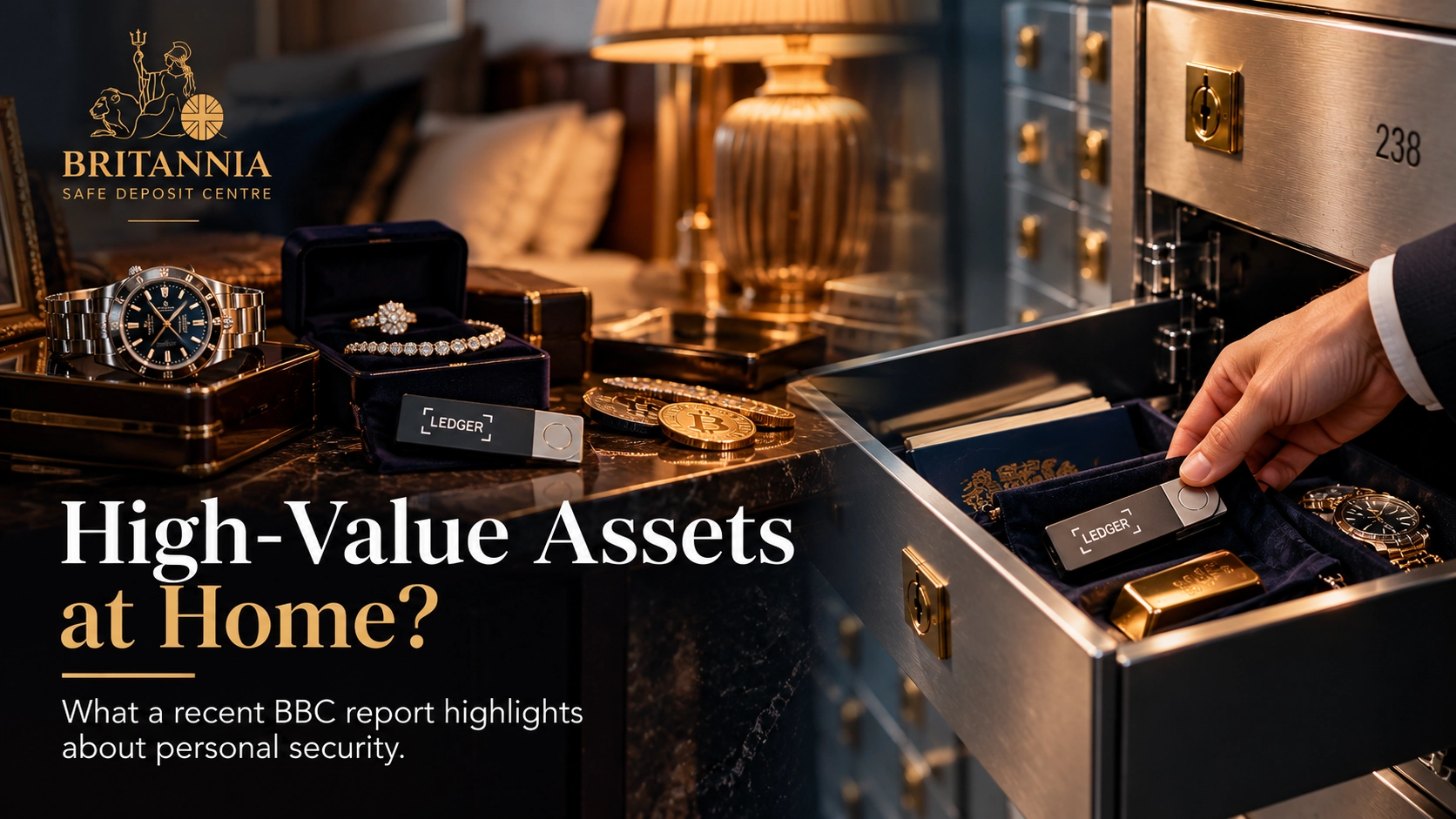
A safe deposit box can provide a dedicated place away from home for suitable physical items, including:
- Jewellery and luxury watches
- Precious metals and coins
- Important documents
- Family heirlooms and sentimental items
- Collectables
- Hardware cryptocurrency wallets and appropriate physical recovery records
The right arrangements will depend on the individual and the asset involved. With cryptocurrency in particular, careful backup and recovery planning is essential.
Security is about more than monetary value
There is an important distinction between something being expensive and something being irreplaceable.
A watch may have significant financial value. A watch inherited from a parent may have both financial and sentimental value.
The same can be true of jewellery, family documents, photographs, medals and other heirlooms.
With a physical device associated with digital assets, its importance may also bear little relation to its physical value.
A small hardware wallet may cost relatively little to purchase, but it can form part of the security arrangements protecting digital assets worth considerably more.
That is why it can be useful to think about security in terms of what an item represents or provides access to, rather than simply how much the physical object itself is worth.
A timely reminder to review how you store valuable possessions
The circumstances reported by the BBC are deeply troubling, and incidents of this severity should not be presented as an everyday occurrence.
Nevertheless, the story provides a timely reminder that protecting valuable assets is not solely about preventing opportunistic burglary.
It can also mean being discreet about what you own, limiting unnecessary information about valuable possessions and considering whether everything of significant value needs to be stored at your home address.
For some items, storing them away from the home may be worth considering.
At Britannia Safe Deposit Centre, we provide safe deposit boxes in a range of sizes for customers looking for a dedicated place to store valuables.
From jewellery, watches and precious metals to important documents, family heirlooms and physical hardware wallets, a safe deposit box can provide a dedicated location for items you do not need to keep at home.
If you would like to discuss which size may be suitable for the items you wish to store, contact the Britannia team to arrange a private visit.
Related reading
5 Things People Commonly Store in a Safe Deposit Box
What Is a Safe Deposit Box and How Does It Work?
Source: BBC News
Ready to protect what matters?
Speak to the Britannia team about your requirements and find the right safe deposit box for the things that matter to you.
Arrange a Private Visit →