When people think about protecting their valuables, the first things that often come to mind are locks, alarms and safes.
All have their place. But good security is rarely about relying on one measure alone.
A strong lock doesn’t replace the need to be careful about who has access to your property. An alarm doesn’t change where your most valuable possessions are kept. And even the most carefully chosen storage arrangement is only one part of a wider approach to protecting what matters.
This is where the idea of layered security becomes useful.
Rather than expecting one solution to do everything, layered security involves considering several different aspects of protection, from physical storage and access to discretion, documentation and insurance.
For anyone keeping jewellery, watches, precious metals, important documents or family heirlooms, it’s a useful way to think about security more broadly.
What does layered security actually mean?
Layered security is the principle of using several complementary measures rather than depending entirely on a single precaution.
Different measures address different risks.
For example, locks and alarms may form part of protecting a property. Careful handling and appropriate packaging help look after the condition of possessions. Insurance may provide financial protection against certain covered losses.
And choosing where valuable items are stored determines whether they need to remain at your home address in the first place.
None of these measures does exactly the same job.
The value of a layered approach is recognising that no single precaution addresses every consideration.
Layer 1: Start with what you’re protecting
Before deciding how to store something, it’s worth understanding what makes it valuable.
For some possessions, the answer is straightforward. Jewellery, watches, gold and other precious metals may have considerable financial value.
Other belongings are important for entirely different reasons.
Family photographs, inherited jewellery, personal documents and sentimental keepsakes may be difficult or impossible to replace.
This distinction matters because the most suitable arrangements for one item may not be appropriate for another.
A watch worn every day, for example, has different storage requirements from a family heirloom that hasn’t been used for years.
A useful starting point is to ask:
- What do I own that is particularly valuable or important?
- How frequently do I need access to it?
- Would it be difficult or impossible to replace?
- Does it genuinely need to remain at home?
- Are my current storage arrangements still appropriate?
These questions can help you make more considered decisions before investing in additional security measures.
Layer 2: Consider physical security at home
For possessions that need to remain at home, sensible physical security is an important consideration.
Door and window security, suitable locks, alarms and appropriate storage arrangements can all form part of protecting a property.
A home safe may also be useful for belongings that require convenient access.
However, a home safe and a safe deposit box serve different purposes.
A home safe keeps possessions within your property. A safe deposit box provides a separate location for storing suitable physical valuables.
Neither option should automatically be regarded as the right choice for every possession.
If you’re considering the differences, our article Home Safe vs Safe Deposit Box: What’s the Difference? explores the practical considerations in more detail.
Layer 3: Think about what people know
Security isn’t only about physical barriers.
It’s also worth considering how much information about your possessions is available to other people.
Social media, photographs, public conversations and everyday habits can sometimes reveal more than intended.
A photograph showing a valuable watch, for example, might seem entirely harmless. But repeatedly sharing details about expensive purchases, collections or where possessions are kept can create unnecessary exposure.
This doesn’t mean people should avoid sharing their interests or enjoying the things they own.
It simply means being thoughtful about what information is made public.
Consider whether posts reveal valuable possessions, whether location information is necessary and who can see the details you share.
Discretion is another useful layer of personal security.
We explored this subject in our previous article, High-Value Assets at Home: What a Recent BBC Report Highlights About Personal Security.
Layer 4: Decide what actually needs to stay at home
One of the most overlooked questions when thinking about security is also one of the simplest:
Does everything valuable need to be kept at home?
Over time, it’s easy to accumulate possessions that are rarely used.
Inherited jewellery, collectable watches, important documents and precious metals may spend months or years in storage without being needed.
For some people, keeping these items at a separate location is worth considering.
This is where safe deposit box security fits into a wider approach to protecting valuables.
Rather than replacing every other precaution, a safe deposit box provides an alternative location for suitable physical possessions that don’t need to remain at home.
At Britannia Safe Deposit Centre, customers can choose from a range of safe deposit box sizes according to their storage requirements.
The decision ultimately comes down to the type of possessions you own, how frequently you need them and your individual circumstances.
Layer 5: Understand how Britannia approaches security
When choosing a private safe deposit facility, it’s reasonable to want to understand the security arrangements in place.
At Britannia Safe Deposit Centre, security is built around several complementary measures rather than a single feature.
The facility occupies a former bank building in Farnworth, Bolton, originally constructed in 1862 by Williams Deacon’s Bank.
Today, Britannia combines that banking heritage with dedicated vault infrastructure, controlled access and modern security systems.
Specialist vault protection
Britannia’s facility includes a Class X CD EX Chubb Centurion six-sided vault, purpose-built by Gunnebo Chubb in Germany.
The vault is tested and certified to European security standard EN 1143-1, with its published classification covering resistance to specified forms of drilling and explosive attack.
Electronic time locks also prevent access to the vault outside normal business hours.
Controlled customer access
Access to restricted areas involves identity verification and biometric iris recognition.
Individual safe deposit boxes use a dual-control locking arrangement requiring both the customer’s key and a custodian key.
These measures provide separate stages of access control rather than relying on a single method of identification or locking.
Monitoring and professional procedures
Britannia’s published security arrangements also include bank-grade alarm systems, monitored CCTV and an anti-ballistic office area.
The facility’s branch security systems are certified to the National Security Inspectorate (NSI) Gold standard.
Britannia also employs staff with banking and security experience and maintains additional security measures that are not publicly disclosed.
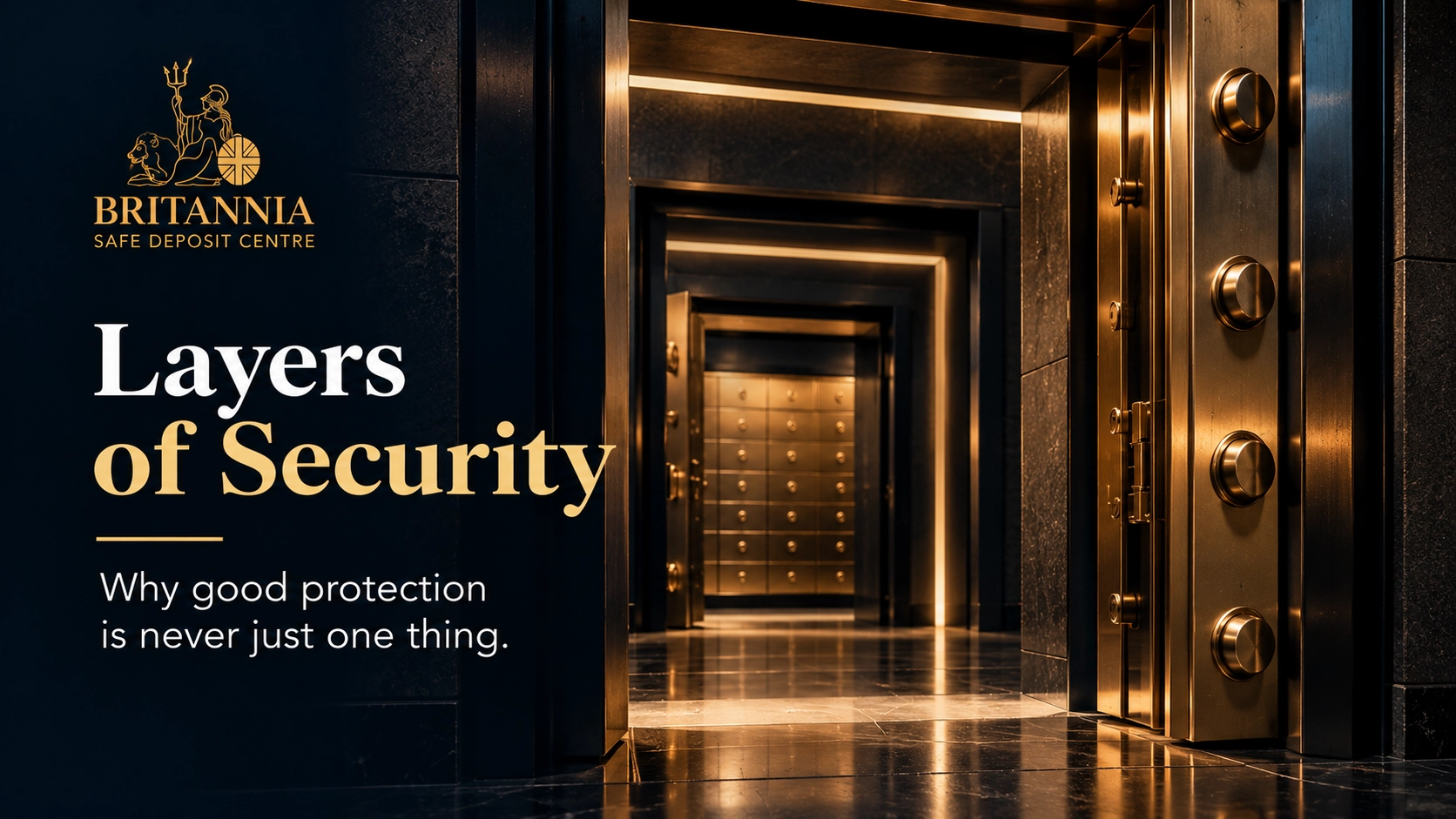
Together, these arrangements demonstrate the principle of layered security in practice, with different systems and procedures serving different purposes.
For further information about the publicly disclosed security features, visit Britannia’s Security page.
Layer 6: Don’t overlook documentation and insurance
Physical storage is only one part of looking after valuable possessions.
Keeping accurate records can be useful, particularly for jewellery, watches, precious metals and other high-value items.
Depending on what you own, this might include photographs, purchase receipts, valuations, certificates and insurance documentation.
For important possessions, consider keeping copies of relevant records separately from the originals.
It’s also sensible to review insurance arrangements periodically.
Insurance doesn’t prevent loss or damage, and cover is always subject to the relevant policy terms. But understanding what protection is available can be an important part of managing financial risk.
Likewise, storing something in a safe deposit box shouldn’t be taken to mean that every possible risk is eliminated.
Britannia recommends that customers arrange suitable insurance for the full value of their stored possessions. Customers should confirm the applicable insurance arrangements and any terms or limitations directly with the team.
You can find more information on Britannia’s Insurance & Valuations page.
Layer 7: Review your arrangements as circumstances change
Security arrangements shouldn’t necessarily remain unchanged forever.
Your circumstances, possessions and priorities may change over time.
You might inherit valuable jewellery, begin collecting watches, purchase precious metals or accumulate important family documents.
Something that was once kept at home for convenience may no longer need to be there.
An occasional review gives you the opportunity to reconsider where items are stored, how they are maintained and whether existing arrangements still suit your needs.
It’s a relatively simple habit that can help prevent important decisions being left to chance.
Why good protection is never just one thing
There’s no single product or precaution that addresses every aspect of protecting valuable possessions.
Physical security, discretion, suitable storage, careful record-keeping and appropriate insurance all serve different purposes.
The most sensible approach is often to consider how these measures work together, rather than expecting one solution to provide complete protection.
For valuables that don’t need to remain at home, a safe deposit box may form one part of that wider approach.
Explore safe deposit boxes at Britannia
Britannia Safe Deposit Centre offers a range of safe deposit box sizes for customers considering dedicated storage away from home.
Whether you’re looking to store jewellery, watches, important documents or other suitable valuables, the team can discuss the available options and explain the process of opening an account.
New customers are encouraged to arrange an appointment in advance so that a member of the team is available to assist.
Contact Britannia Safe Deposit Centre to book a private appointment.
Frequently asked questions
What is layered security?
Layered security means using several complementary precautions rather than relying on a single measure. Different layers may address physical access, storage, privacy, documentation and financial protection.
What security measures does Britannia Safe Deposit Centre have?
Britannia’s publicly disclosed measures include a Class X CD EX Chubb Centurion vault, electronic time locks, biometric iris recognition, dual-control box locking, monitored alarm and CCTV systems, and NSI Gold-certified branch security systems. Further information is available on the centre’s Security page.
Is a safe deposit box more secure than a home safe?
The two serve different purposes, and security depends on the specific arrangements involved. A home safe keeps belongings within your property, while a safe deposit box provides storage at a separate location. Consider access, suitability, the facility’s security arrangements and your individual requirements.
Does a safe deposit box replace home security?
No. A safe deposit box may be useful for possessions stored away from home, but appropriate security for your property and other belongings remains important.
Are valuables automatically insured in a safe deposit box?
Customers should check the applicable insurance arrangements rather than assuming every item is automatically covered for its full value. Britannia recommends suitable insurance and provides information about specialist cover on its Insurance & Valuations page.
Do I need an appointment to access my Britannia safe deposit box?
Existing customers can normally access their boxes during published opening hours without an appointment, subject to the centre’s access procedures. Appointments are recommended for opening a new account or making changes to an existing one.
Related reading
Home Safe vs Safe Deposit Box: What’s the Difference?
High-Value Assets at Home: What a Recent BBC Report Highlights About Personal Security
Ready to protect what matters?
Speak to the Britannia team about your requirements and find the right safe deposit box for the things that matter to you.
Arrange a Private Visit →