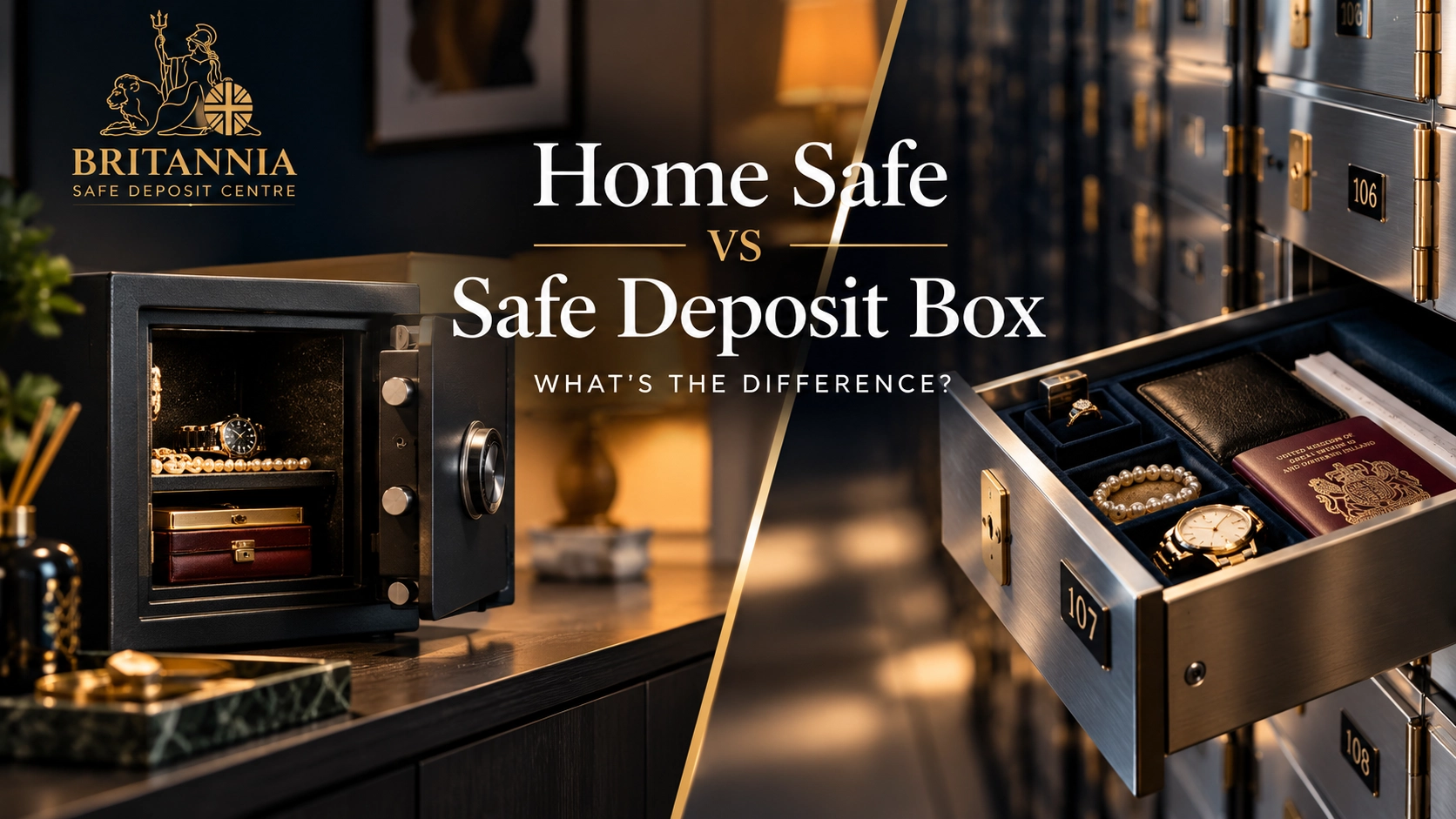
When thinking about where to keep jewellery, watches, important documents or other valuable possessions, two options often come to mind: keeping them in a safe at home or using a safe deposit box.
Both provide a dedicated place for storing valuable items, but there are some important differences between them.
A home safe keeps your possessions within your property and readily accessible. A safe deposit box, on the other hand, allows suitable valuables to be stored at a separate location away from your home.
So, which option is right for you?
The answer often depends on what you are storing, how frequently you need access to it and whether it genuinely needs to remain at home.
What is a home safe?
A home safe is a secure container installed or kept within your property.
Depending on the type of safe you choose, it may be used for jewellery, watches, documents, cash and other personal possessions.
One of the most obvious advantages is convenience. Your belongings remain at home and can be accessed whenever you need them.
That can make a home safe particularly useful for items you use regularly.
However, the location of those possessions remains the same: your home address.
That distinction is one of the biggest differences when comparing a home safe with a safe deposit box.
What is a safe deposit box?
A safe deposit box provides a dedicated place away from your home where suitable physical possessions can be stored.
At Britannia Safe Deposit Centre, customers can choose from a range of safe deposit box sizes depending on what they wish to store.
People may choose to use a safe deposit box for possessions such as:
- Jewellery and watches
- Important documents
- Precious metals and coins
- Family heirlooms and sentimental items
- Collectables
- Other valuable personal belongings
Rather than keeping everything valuable at your home address, a safe deposit box allows selected possessions to be stored separately.
If you’re new to safe deposit boxes, our guide What Is a Safe Deposit Box and How Does It Work? explains the process in more detail.
Home safe vs safe deposit box: the key differences
Location
This is perhaps the most straightforward difference.
A home safe is located within your property. A safe deposit box is located away from your home.
For some people, simply separating certain valuable possessions from their home address is an important consideration.
This doesn’t necessarily mean choosing one option for everything you own. Some belongings may make sense to keep at home, while others may be more suitable for storing elsewhere.
Access
A home safe gives you immediate access to its contents.
That can be useful for jewellery, documents or other belongings you use frequently.
A safe deposit box works differently. You visit the facility when you need access to the items you have stored.
The question to ask is therefore not simply “Which option is better?” but:
“How often do I actually need access to this item?”
If something is used every day, keeping it at home may be more practical.
If it is only used occasionally, storing it away from home may be worth considering.
What you are storing
Not everything valuable has the same purpose.
A watch you wear several times a week is very different from a piece of family jewellery that is taken out once or twice a year.
Similarly, important documents may need to be retained for many years but rarely accessed.
When deciding between a home safe and a safe deposit box, it can therefore help to divide your possessions into two categories:
Things you need regular access to, and things you simply need to keep.
That simple distinction can make the decision much easier.
Does everything valuable need to be kept at home?
This is something worth considering regardless of which storage option you eventually choose.
Over time, valuable possessions can accumulate in a home without us giving much thought to where they are kept.
Jewellery gets passed down through families. Watches are collected. Important documents build up. Precious metals or coins may be purchased as long-term holdings.
Eventually, you may have considerably more stored at home than you actually need there.
Reviewing those possessions occasionally gives you an opportunity to decide what genuinely needs to remain readily accessible.
Some items may need to stay at home. Others may not.
We recently explored this subject further in High-Value Assets at Home: What a Recent BBC Report Highlights About Personal Security.
What about sentimental possessions?
Financial value isn’t the only consideration.
Some possessions would be extremely difficult, or impossible, to replace regardless of their monetary value.
Family jewellery, inherited watches, photographs, documents and other heirlooms can carry a significance that goes far beyond what they might be worth financially.
This is why deciding where something should be stored shouldn’t be based solely on its price.
A useful question is:
“If this disappeared tomorrow, could I replace it?”
If the answer is no, it may be worth giving more thought to where you keep it.
For more examples, read our guide to 5 Things People Commonly Store in a Safe Deposit Box.
Can you use both a home safe and a safe deposit box?
Yes. It doesn’t necessarily have to be one or the other.
For some people, the most practical approach may be to keep frequently used belongings at home while storing items that are used less often in a safe deposit box.
For example, someone might keep the jewellery and watches they regularly wear at home while storing family heirlooms, important documents or other possessions they rarely need elsewhere.
The right arrangement depends entirely on your circumstances and what you own.
Which option is right for you?
When deciding between a home safe and a safe deposit box, there are a few useful questions to consider.
How frequently will I need the item?
If you need regular access, keeping it at home may be more convenient.
Does it need to be at my home address?
Some possessions are kept at home simply because that is where they have always been.
Would the item be difficult or impossible to replace?
Sentimental and irreplaceable belongings may deserve particular consideration.
How much do I need to store?
The amount and type of property you want to store will also influence the most practical option.
There isn’t a single answer that will suit everybody.
The important thing is to make a conscious decision about where your valuable possessions are kept rather than simply leaving them where they have always been.
Safe deposit boxes at Britannia
Britannia Safe Deposit Centre offers a range of safe deposit box sizes for customers looking for a dedicated place to store suitable valuables away from home.
If you’re considering a safe deposit box, the Britannia team can discuss the range of box sizes available and answer any questions you may have.
You can also arrange a private visit to find out more.
Contact Britannia Safe Deposit Centre to book an appointment.
Frequently asked questions
Is a safe deposit box better than a home safe?
Not necessarily. They serve different purposes. A home safe provides convenient access within your property, while a safe deposit box allows suitable possessions to be stored at a separate location away from your home. The right choice depends on what you’re storing and how often you need it.
What can I keep in a safe deposit box?
People may choose to store items such as jewellery, watches, important documents, precious metals, coins, family heirlooms and other suitable personal possessions. You should check with Britannia if you’re unsure whether a particular item can be stored.
Is a safe deposit box suitable for jewellery?
Jewellery is one of the types of possessions people may choose to keep in a safe deposit box, particularly pieces that aren’t worn regularly or have significant financial or sentimental value.
Should I keep important documents at home or in a safe deposit box?
It depends on how frequently you need them. Documents that need to be accessed regularly may be more practical to keep at home, while important documents that are rarely required may be considered for storage elsewhere.
Can I have a home safe and a safe deposit box?
Yes. The two options aren’t mutually exclusive. You may decide to keep frequently used possessions at home while storing less frequently accessed valuables separately.
Related reading
What Is a Safe Deposit Box and How Does It Work?
5 Things People Commonly Store in a Safe Deposit Box
High-Value Assets at Home: What a Recent BBC Report Highlights About Personal Security
Ready to protect what matters?
Speak to the Britannia team about your requirements and find the right safe deposit box for the things that matter to you.
Arrange a Private Visit →